


 IT-
IT- ES-
ES- FR-
FR-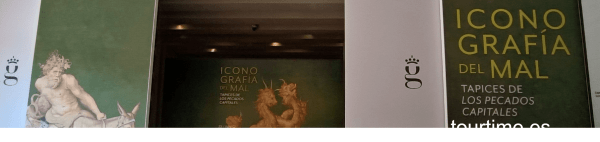
For the first time, the Royal Collections Gallery in Madrid is hosting an unprecedented exhibition that you can’t miss: “The Iconography of Evil,” the tapestries of the seven deadly sins. This new gallery exhibition brings together for the first time two monumental series of 16th-century Flemish tapestries, commissioned by key figures of the European monarchy and preserved for centuries in the Spanish Royal Collections. In this article, we tell you about them and show you some images.
The “Iconography of Evil” exhibition can be visited until September 28, 2025, so you have just a few months to enjoy the once-in-a-lifetime opportunity to admire, without leaving Madrid, ten monumental tapestries, some up to eight meters wide, along with 38 complementary pieces including paintings, books, coins, and sculptures. Tour Time also includes them in its guided tour of the Royal Collections Galleries while the pieces are on display.
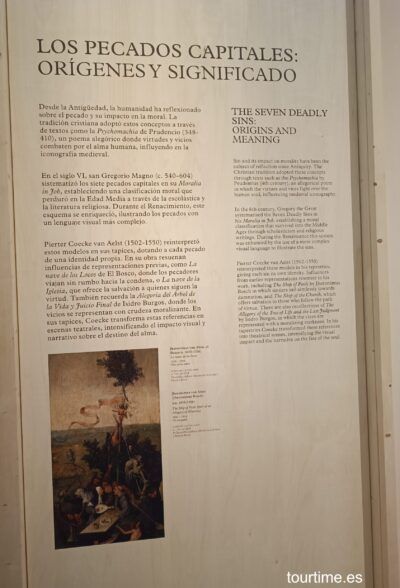
Origins and meaning of the Seven Deadly Sins.
The iconography of the seven deadly sins has deep roots in Christian tradition, representing a moral concept that seeks to categorize the main human faults and their spiritual consequences. In the exhibition, each tapestry not only illustrates a sin greed, lust, anger, gluttony, envy, sloth, and pride but also contrasts the virtue that redeems it: charity versus avarice, chastity versus lust, patience in the face of anger, temperance versus gluttony, generosity as an antidote to envy, diligence to combat laziness, and humility versus pride.
The tapestries’ borders and medallions, with their Latin inscriptions, reinforce the warning message about the dangers of falling into these sins. These works, although often used for decorative purposes, are highly relevant in telling stories and serving as instruments of moral teaching.
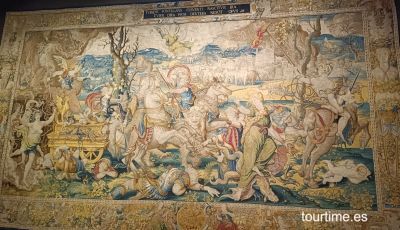
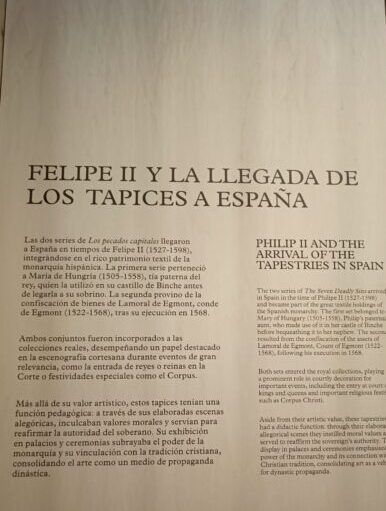
The arrival of the tapestries in Spain with Philip II..
The tapestries on display have an origin as fascinating as their iconography. Four of them come from the collection of Mary of Hungary (1505-1558), aunt of Philip II and ruler of the Netherlands, who commissioned them to decorate her Binche Palace in Brussels for the visit of Emperor Charles V. The second series, consisting of six tapestries, belonged to the Count of Egmont (1522-1568), one of the great Flemish nobles of the time.
In the mid-16th century, Philip II (1527-1598) acquired both series, integrating them into the Spanish Royal Collections, where they remain to this day.
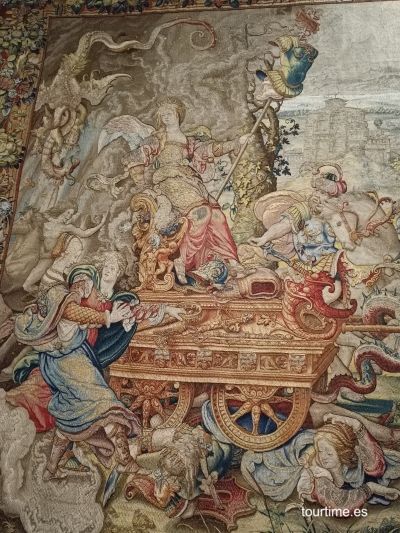
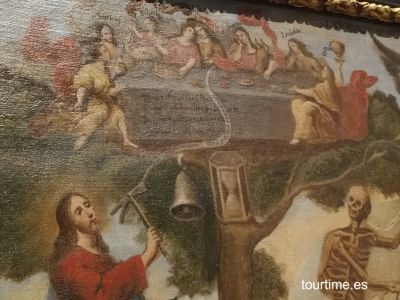
This acquisition was a clear manifestation of power and cultural sophistication. Due to their monumental size and the richness of their materials, such as gold and silk threads, the tapestries were used at court to create striking scenes for ceremonies and celebrations, transforming palace spaces into authentic settings of magnificence and authority.
The choice of these tapestries was not accidental; in the 16th century, Flanders was the main European center of tapestry production, and Brussels workshops, such as that of Wilhelm Pannemaker, achieved great fame.
The original designs, by the Flemish master Pieter Coecke van Aelst (1502–1550), reflect the intellectual and artistic influence of their time, combining religious tradition with the humanist culture of the Renaissance. Furthermore, the acquisition of these pieces by Philip II consolidated the prestige of the Spanish monarchy and its role as patron of the arts, while providing the court with an instrument of moral teaching and political propaganda.
Enjoy a thematic and multi-sensory tour.
The exhibition is divided into five thematic sections that explore the role of tapestries as instruments of moral teaching, symbols of power, and transformative elements of courtly space. It also includes previously unseen pieces and notable loans, such as a manuscript from the National Library of Spain (1546-1553) that documents the importance of these tapestries in the Habsburg court.
The tapestries are in excellent condition, allowing one to appreciate their rich colors and meticulous detail, from scenes of consuming greed to the arrogance punished by the fall of the Tower of Babel.
The monumental art of Flemish tapestries.
The making of a 16th-century Flemish tapestry, like those on display in the Royal Collections Gallery, was a truly collective feat that could take several years. The process required meticulous coordination of resources, talent, and time: for a large-format tapestry like those in the Seven Deadly Sins series, which reach up to eight meters in width, it was common for 10 to 20 specialized weavers to work simultaneously on the same loom, each responsible for a specific section of the design.
The time required to complete a piece of such magnitude varied depending on the complexity of the cartoon (the original drawing), the richness of the details, and the quantity of gold, silk, and wool threads used. For example, a tapestry of this size could require one to two years of uninterrupted work to achieve the quality demanded by European nobility and royalty.
Brussels workshops, such as Wilhelm Pannemaker’s, were organized into hierarchical teams: the master weaver supervised the process, while journeymen and apprentices wove under his direction, faithfully following the cartoons created by artists such as Pieter Coecke van Aelst.
One of the most iconic tapestries in the series is the one dedicated to Avarice, where the central figure is surrounded by symbols and allegories, with a dense and meticulous composition. In pieces like this, the richness of color and the presence of metallic threads required even greater skill and time, as each color and texture had to be integrated by hand, following the pattern established by the original cartoon.
Coordination was essential: while some wove the backgrounds, others focused on the details of the figures, draperies, or architectural elements.
Furthermore, the creation of these tapestries involved the collaboration of other trades: dyers, who prepared the colors; draftsmen and painters, who produced the cartoons; and merchants who managed the acquisition of materials such as Castilian wool, silk, and gold, essential to the tapestry’s final quality.
The monumentality and attention to detail of these pieces not only reflect the power of their owners, but also the technical excellence and organization of Flemish workshops in the 16th century. Viewing these works today is a glimpse into a craft process that marked the splendor of European textile art.
Today, these tapestries are one of the most valuable treasures of the National Heritage, and their conservation and study continue to be a priority, given their historical and artistic importance. The current exhibition allows, for the first time, a close look at both series and a detailed appreciation of their iconographic complexity and extraordinary technical quality.
At Tour Time, we customize each tour to suit your specific interests. If you would like to include specific details, such as a visit to the tapestries of the seven deadly sins or exploring other artistic gems in the collection, simply request it. We create a unique, tailor-made experience for you so you can enjoy Madrid’s historical and artistic heritage in a truly unique way. Don’t forget to take advantage of the views and atmosphere of this unique space, where art and history intertwine to create an unforgettable experience.
